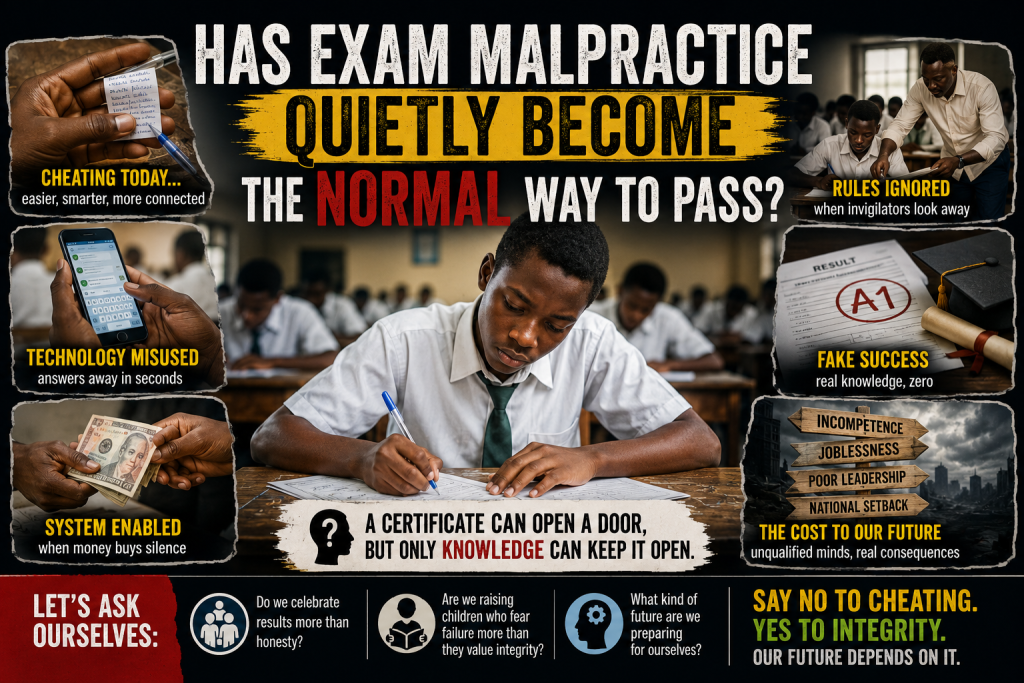
 One question has been on my mind for quite some time, and I honestly believe it is a question that deserves a sincere answer from every one of us, regardless of whether we are students, parents, teachers, school owners, employers, or policymakers. Has examination malpractice quietly become the normal way to pass? Before you rush to answer, take a moment to reflect on what you have seen, heard, or even experienced over the years.
There was a time when examination malpractice was something people feared. Students who cheated in examinations rarely admitted it openly because it carried shame and embarrassment. Parents discouraged it, teachers condemned it, and schools that became associated with malpractice risked damaging their reputations. Success achieved through dishonest means was generally viewed as something to hide rather than celebrate. Unfortunately, the atmosphere today appears to be changing, and that change should concern every one of us.
Listen carefully to the conversations that take place before major examinations. Years ago, students would gather to discuss difficult topics, exchange revision notes, solve past questions together, and encourage one another to study harder. Today, those conversations sometimes sound very different. Instead of asking whether someone has completed their revision or understood a difficult topic, the questions often revolve around whether examination questions have leaked, whether someone has access to “expo,” whether a particular examination centre is known for assisting candidates, or whether an invigilator can be influenced. In some cases, students who genuinely spend months preparing for an examination are even mocked for “working too hard” because others believe there are easier ways to obtain the same results.
When did we arrive at this point? When did studying become something to laugh at while cheating became something to admire? More importantly, when did honesty become a disadvantage in an environment that is supposed to reward hard work and genuine learning?
These are uncomfortable questions, but they are questions we cannot continue to avoid. The truth is that examination malpractice is no longer an issue that concerns only the student who decides to cheat. It has gradually become a societal issue because many different people now contribute, directly or indirectly, to sustaining it. Some parents, driven by fear that their children may not perform well, unknowingly encourage dishonest practices by paying for illegal assistance. Some schools become obsessed with maintaining impressive pass rates because they believe outstanding examination results attract more admissions and enhance their public image. Some invigilators fail to enforce examination rules strictly, while advances in technology have created entirely new methods of cheating that previous generations could never have imagined. When all these factors come together, examination malpractice slowly begins to appear normal rather than exceptional.
Yet we should pause and ask ourselves a much deeper question. If everyone begins to rely on dishonest shortcuts to achieve success, what eventually happens to the meaning and value of success itself? Imagine two students sitting in the same examination hall. One has spent months sacrificing sleep, reducing leisure activities, attending extra lessons, solving countless practice questions, and genuinely striving to understand every topic on the syllabus. The other enters the examination hall expecting leaked questions, hidden notes, unauthorized assistance, or answers sent through digital devices. At the end of the examination, both students obtain similar grades. Which of the two has truly earned that success? More importantly, what lesson has society just taught both of them? Have we unintentionally communicated that integrity is optional as long as impressive results are achieved?
Many people argue that the enormous pressure placed on students today explains why examination malpractice has become so widespread. Parents expect distinctions because they want the best opportunities for their children. Schools compete fiercely to advertise exceptional examination results as a way of attracting new students. Universities have limited admission spaces, making competition increasingly intense. Employers often use academic grades as one of the first criteria for selecting job applicants. These realities undoubtedly create significant pressure, and it would be unfair to ignore them. However, acknowledging pressure is very different from justifying dishonesty. If we begin to accept examination malpractice because students are under pressure, what moral argument will remain when those same individuals later justify corruption in public office, financial fraud in business, falsification of official records, or professional negligence because they are also under pressure? Perhaps examination malpractice is not merely an educational problem; perhaps it represents the beginning of a much larger ethical crisis that eventually spreads into every sector of society.
 The Federal Government of Nigeria has repeatedly recognised the seriousness of this challenge and has continued introducing measures aimed at restoring credibility to public examinations. Authorities have strengthened oversight during WAEC and NECO examinations, introduced stricter monitoring procedures, expanded the use of computer-based assessments in some examinations, and encouraged greater use of technology to detect irregularities. These reforms demonstrate that policymakers understand the long-term consequences of allowing examination malpractice to continue unchecked. When examinations lose credibility, certificates gradually lose their value. When certificates lose their value, employers begin to question the competence of graduates, universities struggle to distinguish genuinely prepared candidates from those who obtained results dishonestly, and public confidence in the entire education system begins to erode.
Recent statistics further illustrate the magnitude of the problem. During the 2024 West African Senior School Certificate Examination conducted by WAEC, the results of more than 215,000 candidates were withheld because of alleged examination malpractice. This represented almost twelve percent of all candidates who sat for the examination. Around the same period, the National Examinations Council (NECO) disclosed that forty secondary schools across seventeen states had been implicated in cases of mass cheating during the Senior School Certificate Examination, even though the council also reported an overall reduction in malpractice compared to the previous year. These figures should not merely be viewed as statistics. They represent hundreds of thousands of young people whose educational journeys have been affected by dishonesty and whose futures may now be uncertain.
Perhaps the most disturbing aspect of these statistics is that they only account for cases that were actually detected. They naturally raise another question that many of us may find difficult to answer honestly. How many cases of examination malpractice occur without ever being discovered? If thousands of candidates are caught each year despite increasingly sophisticated monitoring systems, how many others escape detection? This possibility should concern anyone who values education because it suggests that the visible cases may represent only a fraction of a much larger problem.
Technology has also transformed the nature of examination malpractice. Years ago, cheating often involved handwritten notes hidden inside pockets, textbooks concealed under desks, or whispered conversations between candidates. Today, the methods have become considerably more sophisticated. Mobile phones, encrypted messaging applications, miniature communication devices, impersonation, organised examination syndicates, and digital collaboration have introduced entirely new dimensions to the problem. Ironically, however, the same technology that has made cheating easier also offers some of the most promising solutions. Computer-based testing, biometric verification, artificial intelligence-assisted monitoring, encrypted question delivery systems, automated candidate verification, and sophisticated surveillance technologies are gradually making it more difficult to manipulate examinations. Nevertheless, no amount of technological innovation can completely solve a problem that is fundamentally rooted in human values and personal integrity.
This brings us to another important question that perhaps deserves even greater attention than the methods of cheating themselves. Why do so many students genuinely believe that they cannot succeed without cheating? Is it because they lack confidence in their own abilities? Is it because our educational system has unintentionally placed so much emphasis on passing examinations that genuine learning has become secondary? Have we created an environment where students memorise information simply to obtain high grades rather than to develop knowledge, critical thinking, creativity, and problem-solving skills that will serve them throughout life?
The consequences of examination malpractice extend far beyond the examination hall. Imagine receiving medical treatment from a doctor who cheated throughout medical school. Would you confidently place your life or the life of someone you love in that doctor’s hands? Imagine driving across a bridge designed by an engineer who obtained professional qualifications through dishonest means. Would you feel completely safe? Consider a lawyer who cheated throughout law school or an accountant who never truly mastered financial principles. Suddenly, examination malpractice is no longer just about passing an examination. It becomes a matter of public safety, economic development, professional competence, and national progress. Every dishonest certificate issued today has the potential to become tomorrow’s incompetent professional.
At this point, it is important to recognise that this conversation is not intended to condemn every student, teacher, parent, or school. Many students continue to study diligently despite enormous challenges and succeed honestly through hard work and perseverance. Thousands of teachers remain deeply committed to academic integrity, often resisting pressure from parents, school administrators, and even students themselves. Likewise, many school owners have refused to compromise their ethical standards despite operating in an increasingly competitive educational environment where impressive examination results are often used as marketing tools. These individuals deserve recognition because they demonstrate that integrity remains possible even under difficult circumstances.
Perhaps, therefore, the real challenge before us is not simply how to catch more students who cheat but how to rebuild a culture where honesty is respected, hard work is rewarded, and genuine learning becomes more important than examination scores alone. We need parents who celebrate effort as much as they celebrate grades. We need schools that prioritise learning over publicity. We need teachers who inspire curiosity rather than fear, policymakers who continue strengthening examination systems, employers who value competence alongside certificates, and students who understand that temporary failure achieved honestly is infinitely more valuable than dishonest success that eventually destroys character.
As I conclude, I would like each of us to reflect honestly on a few personal questions. If you are a student, have you ever felt pressured to engage in examination malpractice simply because everyone around you seemed to believe it was the easiest path to success? If you are a parent, would you rather your child fail honestly today and learn valuable lessons about perseverance, or pass through dishonest means and carry that burden into adulthood? If you are a teacher or examination invigilator, what challenges make it difficult to uphold examination integrity consistently? If you own or manage a school, have market competition and the desire for excellent pass rates ever tempted you to compromise ethical standards? And finally, if you were given the opportunity to change just one thing about Nigeria’s examination system, what would you change, and why?
These are not easy questions, but perhaps they are exactly the questions we need to ask if we genuinely want to restore confidence in our education system. After all, examinations measure what we know at a particular moment, but integrity measures who we are throughout our entire lives. A certificate may open the first door of opportunity, but it is competence, honesty, and character that determine how far we eventually go.
References
- Federal Ministry of Education. FG Introduces New Measures to Eliminate WAEC & NECO Examination Malpractice. https://fmino.gov.ng/fg-introduces-new-measures-to-eliminate-waec-neco-examination-malpractice-in-2026/
- The ICIR. WAEC Withholds Results of Over 215,000 Candidates Over Examination Malpractice. https://www.icirnigeria.org/waec-withholds-results-of-over-215000-candidates-over-examination-malpractice/
- The Star Nigeria. 2024 SSCE: NECO Summons 40 Schools Over Examination Malpractice. https://www.thestar.ng/2024-ssce-neco-summons-40-schools-over-exam-malpractice/
- Joint Admissions and Matriculation Board (JAMB). JAMB Bulletin – CBT Security and Examination Integrity Initiatives. https://www.jamb.gov.ng/Bulletin/
- ScienceDirect. Research on Emerging Trends in Examination Malpractice and Technology-Assisted Cheating. https://www.sciencedirect.com/science/article/abs/pii/S0738059323000871